
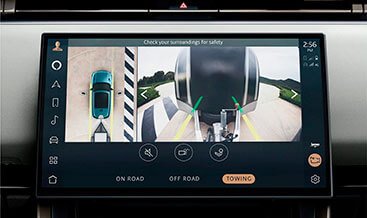


Advanced Tow Assist – OEM ADAS Towing Activation for Jaguar and Land Rover
Advanced Tow Assist is the factory driver-assistance function that takes the counter-steering out of trailer reversing. The system reads the trailer’s position through the surround camera array, combines that image data with Tow Bar Control Module (TBCM) and steering-angle inputs, and calculates the trajectory required to place the trailer on the driver’s chosen path. The driver controls speed with the pedals and sets direction with the Terrain Response rotary controller; the vehicle performs the steering corrections automatically[reference:1].
Most current-generation JLR vehicles leave the factory with the necessary TBCM, surround camera hardware, and towing-assist ECU logic already installed[reference:2]. JLR nevertheless disables the function on many standard and mid-tier trims through locked CCF configuration parameters. The hardware exists, the calibration data exists, and the HMI assets exist, but the gateway refuses to expose the towing menu because the vehicle’s as-built file declares the feature absent. This activation resolves that mismatch at configuration level. It releases the dormant OEM algorithms without adding aftermarket modules, altering wiring, or flashing unverified firmware[reference:3].
System Architecture: How the Towing ADAS Pipeline Operates
Advanced Tow Assist sits inside the vehicle’s ADAS towing stack rather than functioning as a standalone reversing aid. The surround camera system supplies the raw image feed. The TBCM contributes trailer electrical-state data and hitch recognition. The steering-angle sensor and ABS module provide vehicle-motion inputs. The integration controller fuses these streams, builds a trailer-trajectory model, and issues counter-steer commands to the steering system while the driver retains pedal authority[reference:4].
On Pivi Pro and InControl Touch Pro platforms, the function renders dynamic colour-coded trajectory lines over the rear and side camera views. These lines update in real time as the trailer angle changes, and the system actively compensates for trailer angles that would otherwise produce a jackknife. The driver sees the predicted path before the trailer occupies it, which removes the blind-spot guesswork that makes tight reversing difficult[reference:5].
Why Standard-Spec Vehicles Need a CCF Activation
JLR structures feature availability through the Car Configuration File. The CCF declares which modules and functions the vehicle carries, and the gateway enforces that declaration. When a factory build excludes Advanced Tow Assist from the ordered specification, the CCF carries the feature as disabled even though the physical TBCM and camera hardware remain fitted. The vehicle then offers only basic trailer stability control and static parking guidelines; the intelligent reverse-steering layer stays dormant[reference:6][reference:7].
This is why the activation is a configuration procedure, not a hardware retrofit. The technician applies official CCF parameter edits through JLR Pathfinder, releases the towing-assist feature set, resets the affected modules, and validates that the Advanced Tow Assist menu becomes visible on the infotainment display. The process remains fully reversible: the original configuration backs up before any change, and a simple rollback restores the factory baseline for warranty servicing or resale[reference:8][reference:9].
Activation Workflow and Functional Validation
The procedure begins with a full pre-program diagnostic scan that confirms VIN, module health, camera configuration, trailer electrics, and CCF eligibility[reference:10]. The technician then captures a complete backup of the original vehicle configuration. Pathfinder applies the validated CCF edits that enable the Advanced Tow Assist parameter set. Module resets follow, and the infotainment system reloads the towing-assist application and calibration data.
Post-coding validation confirms menu visibility, camera-trajectory accuracy, automatic steering response, and TBCM synchronisation. The technician clears residual faults and verifies that the ADAS towing stack communicates cleanly across the CAN and Ethernet networks. On vehicles with Pivi Pro, the calibration stage also verifies that the dynamic trajectory overlay renders correctly against the surround-camera feed[reference:11].
On-Vehicle Trailer Calibration
Activation makes the function available; trailer-specific calibration makes it accurate. The driver creates a trailer profile inside the infotainment system and enters the measured trailer dimensions, including axle details. The setup requires a measuring tape and the supplied three-dot target sticker, which the driver positions precisely on the trailer’s front face according to the rear-camera targeting guide. The system then learns the trailer’s geometry and stores the profile for repeated use.
This calibration step belongs to the normal user workflow rather than the coding session, but it determines whether the trajectory predictions match the actual trailer. Technicians should guide the owner through the sticker placement and dimension entry during handover so the first real reversing manoeuvre delivers the expected accuracy.
Compatibility and Hardware Prerequisites
This activation supports modern JLR platforms fitted with factory TBCM and surround camera hardware, including the Defender L663, New Range Rover L460, Range Rover Sport L461, Range Rover Sport L494, Range Rover Velar, Range Rover Evoque, and Jaguar F-Pace X761, together with other current Jaguar premium variants that carry the same towing-assist ECU logic[reference:13]. Model-year coverage varies by platform; the L460 requires MY24 or later for this feature set[reference:14].
Coding alone cannot add missing physical hardware. The vehicle must carry the surround camera system or a rear camera with a suitable processing module, a factory tow pack or compatible trailer module, Pivi Pro or InControl Touch Pro infotainment, and the correct steering-wheel and rotary controls[reference:15]. Where the TBCM or camera components are absent, a hardware retrofit must precede activation. Submit the VIN during checkout so the technical team completes a compatibility assessment before dispatch.
Frequently Asked Questions
Does this activation add aftermarket modules or wiring?
No. The procedure uses pure factory CCF parameter enablement. It releases OEM towing-assist algorithms that already reside in the vehicle’s modules and introduces no aftermarket hardware, no wiring alterations, and no unverified ECU firmware flashes[reference:16].
Will the activation affect my factory warranty or ADAS functions?
The change uses reversible configuration edits, and the original CCF backs up before any modification. Factory safety systems, emissions programming, and diagnostic protocols remain intact. A rollback restores the original configuration whenever the vehicle returns to dealer servicing[reference:17].
My vehicle has the tow bar but no Advanced Tow Assist menu. Why?
A factory tow bar does not automatically include the ADAS towing function. JLR controls availability through the CCF, and many standard-spec builds carry the hardware while the feature remains disabled in configuration. The activation releases that parameter lock[reference:18].
Can I use Advanced Tow Assist with multiple trailers?
Yes. The infotainment system stores individual trailer profiles with their calibrated dimensions. You select the active profile before reversing, and the trajectory model adapts to that trailer’s geometry[reference:19].
Order the Advanced Tow Assist Activation
Release the factory towing intelligence your JLR vehicle already carries. Add the Advanced Tow Assist activation to your cart and provide your VIN at checkout so the technical team confirms TBCM and camera eligibility before scheduling the Pathfinder session. For pre-activation diagnostics or platform-specific questions, contact the lr-retrofit.com coding team before ordering.