

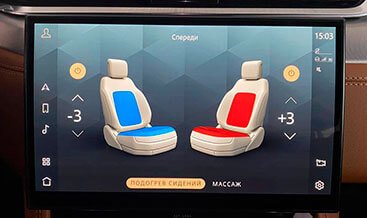


Ventilated Seats vs Cooled Seats
Not all seat cooling is the same. The terms “ventilated seats” and “cooled seats” are often used interchangeably, but they describe two distinct technologies. Ventilated seats rely on blowers to push cabin air through the seat surface, providing a cooling sensation through evaporation. Cooled seats, by contrast, use thermoelectric devices to actively chill the air before it reaches the occupant. This page explains the difference and helps you choose the right upgrade for your JLR vehicle.
Technology Comparison
| Feature | Ventilated Seats | Cooled Seats (Active) |
|---|---|---|
| Cooling Mechanism | Evaporative & convective; uses cabin air | Thermoelectric (Peltier) element chills air before delivery |
| Air Source | Cabin air drawn from under the seat | Same, but air passes through a cold‑side heat exchanger |
| Temperature Drop | Typically 2–4°C below ambient seat surface | Can achieve 8–12°C below ambient seat surface |
| Component Complexity | 2x axial fans, simple PWM controller | 2x fans, Peltier module, heat sink, hot‑side exhaust fan, and separate controller |
| Power Consumption | ~2.5 A per seat at max speed | ~6–8 A per seat when cooling actively |
| Noise Level | Low, fan‑only hum | Slightly higher due to additional hot‑side fan |
| JLR Application | Standard “Climate Seats” on many models | “Premium Climate Seats” or “Active Cooled Seats” on high‑end trims |
How Ventilated Seats Work
In a ventilated seat system, two brushless axial fans are mounted inside the seat cushion and backrest. They draw cabin air from the footwell area and push it through a network of channels in the foam, finally exiting through the perforations in the leather. The moving air accelerates the evaporation of moisture from the occupant’s body, creating a cooling sensation even though the air temperature is the same as the cabin. The system is simple, effective, and has minimal impact on the vehicle’s electrical load.
JLR’s ventilated seats are typically found on the Range Rover Sport and Velar, and can be retrofitted to any compatible vehicle with perforated leather. The control interface is integrated into the climate seat screen, with three fan speeds and independent driver/passenger control.
How Cooled Seats Work
Cooled seats take the ventilation concept a step further by incorporating a thermoelectric Peltier element. The Peltier module creates a temperature differential when current is applied: one side becomes cold, the other hot. Air drawn into the seat is passed over the cold side, lowering its temperature by up to 12°C, before being expelled through the seat perforations. The hot side is actively cooled by a separate exhaust fan that rejects heat into the cabin or under the seat.
This active cooling provides a much more pronounced sensation, making the seat surface feel cold to the touch within minutes. The system is often bundled with heating elements to create a full “climate seat” package. JLR’s “Premium Climate Seats” on the Range Rover Autobiography and SV trims use this technology. Retrofitting cooled seats requires a more complex installation, including the Peltier module, additional heat management, and upgraded wiring, but the result is a genuine luxury experience.
Which Should You Choose?
The choice between ventilated and cooled seats depends on your climate, preferences, and vehicle compatibility. For most UK drivers, ventilated seats provide ample comfort on warm days, with a proven design that adds minimal complexity. If you frequently travel in hotter climates or desire the highest level of seat cooling, the actively cooled seat upgrade is the definitive solution.
Both systems can be retrofitted by LR Retrofit. During a consultation, we assess your vehicle’s seat design, leather condition, and electrical system to determine the most suitable upgrade. In many cases, we can even combine the two systems – ventilated for the rear seats and actively cooled for the front.
| Make Model | New Range Rover Sport 2023+ |
|---|
Related products
Retrofits Upgrades
Retrofits Upgrades

Retrofits Upgrades
Retrofits Upgrades
Retrofits Upgrades

Retrofits Upgrades
Retrofits Upgrades
Retrofits Upgrades