

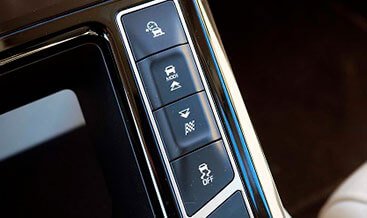


Adaptive Surface Response (ADSR)
Adaptive Surface Response (ADSR) activates the factory surface detection and traction optimisation system on compatible Jaguar and Land Rover vehicles. ADSR replaces the standard Winter mode in JaguarDrive Control and automatically identifies the surface beneath the vehicle. It then adjusts throttle mapping, transmission behaviour, and Dynamic Stability Control intervention to maximise available traction. You select ADSR once, and the system works at all speeds to keep you composed in adverse weather and across challenging surfaces. This OEM retrofit activates the feature through VIN-specific configuration, so you gain factory behaviour rather than an aftermarket compromise.
How Adaptive Surface Response Works
ADSR leverages Jaguar Land Rover’s world-leading expertise in All-Wheel Drive technologies and traction systems. The system constantly monitors the vehicle’s environment through existing sensor inputs. It distinguishes between different types of surface and adjusts the mapping of the powertrain and Dynamic Stability Control system according to the conditions.
When ADSR detects a low-friction surface such as wet tarmac, ice, snow, mud, deep gravel, or sand, it remaps throttle response for smoother power delivery. It also adjusts the Intelligent Driveline Dynamics system to manage torque transfer between the front and rear axles. The Dynamic Stability Control system receives revised intervention thresholds, which allows the vehicle to maintain momentum without excessive braking or torque reduction.
ADSR replaces the Rain/Ice/Snow mode in JaguarDrive Control and sits in the same selection row as Dynamic and Eco modes. On Land Rover vehicles equipped with Terrain Response 2, ADSR integrates as an automatic surface detection layer. The system works at all speeds and operates transparently, so you simply select the mode and drive with confidence.
Our activation service writes the correct Car Configuration File parameters to the Chassis Control Module, the All-Wheel Drive Control Module, the Dynamic Stability Control Module, and the Gateway Module. We align every value with your vehicle’s VIN and build data, which ensures the surface detection logic, the torque management, and the driver display all communicate correctly.
Key Features
- Automatic surface detection identifies wet, icy, snowy, muddy, gravel, and sandy conditions without driver input.
- Powertrain remapping adjusts throttle sensitivity and transmission shift strategy for smooth power delivery on low-friction surfaces.
- Dynamic Stability Control optimisation revises intervention thresholds to maintain momentum while preserving safety.
- Intelligent Driveline Dynamics integration manages torque transfer between front and rear axles for optimal traction.
- All-speed operation maintains surface adaptation from walking pace through motorway cruising.
- JaguarDrive Control integration replaces Winter mode with an intelligent, self-adjusting alternative.
- Terrain Response 2 compatibility adds automatic surface detection on Land Rover vehicles equipped with the advanced terrain system.
- Full factory integration delivers the same behaviour as a factory-ordered option.
- No hardware replacement preserves your existing sensors, control modules, and driveline components.
- Diagnostic-safe programming generates no fault codes and preserves the original as-built configuration.
Technical Specifications
| Parameter | Specification |
|---|---|
| System Name | Adaptive Surface Response (ADSR) |
| Primary Modules | Chassis Control Module, All-Wheel Drive Control Module, Dynamic Stability Control Module |
| Supporting Modules | Gateway Module, Engine Control Module, Transmission Control Module |
| Detection Method | Sensor-based surface classification using existing vehicle inputs |
| Adjustment Parameters | Throttle mapping, transmission shift strategy, DSC intervention thresholds, torque distribution |
| Operating Speed Range | All speeds from standstill to maximum vehicle speed |
| Drive Control Integration | Replaces Winter mode in JaguarDrive Control |
| Terrain Response Compatibility | Integrates with Terrain Response 2 on Land Rover vehicles |
| Drivetrain Requirement | All-Wheel Drive (AWD) |
| Supported Surfaces | Wet tarmac, ice, snow, mud, deep gravel, sand, mixed surfaces |
| Activation Method | VIN-specific CCF configuration via JLR-approved diagnostic pathway |
| Reversibility | Fully reversible through the archived original configuration |
Vehicle Compatibility
Adaptive Surface Response supports a broad range of Jaguar and Land Rover vehicles equipped with All-Wheel Drive and compatible chassis hardware. Compatible models include:
- Range Rover (L405, L460)
- Range Rover Sport (L494, L461)
- Range Rover Velar (L560)
- Range Rover Evoque (L538, L551)
- Discovery (L462) and Discovery Sport (L550)
- Defender (L663)
- Jaguar F-Pace, E-Pace, I-Pace
- Jaguar XE, XF, and XJ models with All-Wheel Drive and compatible chassis hardware
Your vehicle must carry an All-Wheel Drive system and a Dynamic Stability Control module that supports ADSR parameters. The vehicle also needs a JaguarDrive Control or Terrain Response selector with the appropriate mode configuration. We verify your VIN, your driveline specification, and your chassis module calibration before we begin. Vehicles equipped with Adaptive Dynamics and Configurable Dynamics gain the greatest benefit from ADSR activation, because the system coordinates with the continuously variable damping system for optimal body control.
What the Activation Includes
Every ADSR activation includes a comprehensive configuration service tailored to your vehicle:
- Pre-programming hardware verification covering AWD presence, chassis module capability, and drive control selector configuration.
- VIN-specific CCF editing to enable ADSR parameters across the Chassis Control Module, AWD Control Module, and DSC Module.
- Complete CCF backup before modification to preserve your vehicle’s original as-built data.
- Module reset and network synchronisation across all affected control modules.
- Functional verification of mode selection, surface detection logic, and driver display integration.
- Road testing to confirm throttle response, torque distribution, and stability control behaviour.
- Remote support documentation for your local workshop or independent specialist.
| Make Model | I-PACE 2018-2020 |
|---|
Related products

Features Activation
Features Activation

Features Activation
Features Activation

Features Activation

Features Activation

Features Activation
Features Activation