


Electronic Modules Software Update
Electronic Modules Software Update brings every control module in your Jaguar or Land Rover up to the latest software level that JLR released for your VIN. Manufacturers refine module calibration throughout a vehicle’s production life, and those refinements improve shift quality, engine response, sensor accuracy, and system stability. This service reads your vehicle’s module inventory, retrieves the correct software files against your build record, and flashes each module through the JLR-approved diagnostic pathway. You gain the same software state that a main dealer would apply, with full backup, verification, and documentation.
Why Module Software Becomes Outdated
JLR releases module software updates continuously. A vehicle built in one model year often runs calibration files that the factory has since superseded. Powertrain modules receive revised torque models and shift maps. Driver assistance modules receive improved object recognition routines. Infotainment modules receive stability fixes and interface corrections. Body modules receive revised comfort logic and lighting behaviour.
Three situations make an update worthwhile. First, a vehicle that has missed dealer service intervals carries several generations of outdated calibration. Second, a module replacement introduces a unit running base software that no longer matches the rest of the network. Third, a retrofit installation requires a specific software level to support the newly activated feature. In every case, an update restores consistent behaviour across the whole vehicle network.
How the Update Service Works
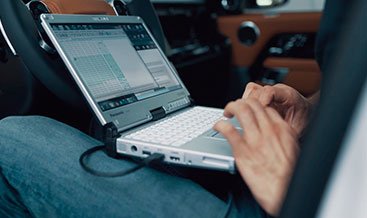
We connect a JLR-approved DOIP VCI interface to the vehicle’s diagnostic port and read the complete module inventory. The diagnostic platform queries each module and reports its current software level, hardware part number, and serial data. We compare that inventory against your VIN build record and identify every module that carries a superseded calibration.
We then capture a full backup of your existing configuration, including the Car Configuration File (CCF) and every module’s as-built data. This archive allows complete reversibility. Next, we download the correct software files and flash each module in the sequence that the diagnostic platform specifies. Programming order matters, because the Gateway Module coordinates communication and certain modules depend on others reaching the correct level first.
After flashing, we clear adaptation values where the platform requires it, reset every module, and run a full network scan to confirm that no fault codes remain. A road test verifies driveability, shift quality, and system response. We finish with written documentation listing each module, its previous software level, and its new software level.
Key Features
- VIN-specific software retrieval downloads only the calibration files that JLR released for your exact build.
- Complete module inventory scan reports current software level, hardware part number, and superseded status for every ECU.
- Full configuration backup captures the CCF and all as-built data before any write.
- Correct programming sequence respects Gateway Module coordination and inter-module dependencies.
- Multi-system coverage spans powertrain, chassis, body, driver assistance, and infotainment modules.
- Network verification runs a complete scan after flashing to confirm a fault-free state.
- Adaptation reset restores learned values so the vehicle relearns your driving patterns cleanly.
- Road test confirmation validates driveability, shift quality, and system response after the update.
- Written documentation records every module’s previous and new software level.
- Complete reversibility through the archived backup if you ever need to restore the original state.
Technical Specifications
| Parameter | Specification |
|---|---|
| Service Name | Electronic Modules Software Update |
| Diagnostic Platform | JLR-approved diagnostic pathway with DOIP VCI interface |
| Supported Buses | CAN-HS, CAN-MS, CAN-LS, LIN, FlexRay, Automotive Ethernet |
| Typical Modules Covered | ECM, TCM, ABS/DSC, BCM, IPMA, PAM, GWM, HVAC, Infotainment Head Unit, Instrument Cluster |
| Software Source | VIN-specific calibration files retrieved against your build record |
| Backup Protocol | Full CCF and as-built archive captured before modification |
| Programming Sequence | Gateway-coordinated order respecting inter-module dependencies |
| Post-Update Verification | Complete network scan, adaptation reset, and road test |
| Power Supply Requirement | Stabilised workshop charger maintaining voltage throughout flashing |
| Typical Duration | 2 to 5 hours depending on module count and software volume |
| Reversibility | Fully reversible through the archived original configuration |
Vehicle Compatibility
This service supports Jaguar and Land Rover vehicles that use a writable Car Configuration File and JLR-approved diagnostic access. Compatible models include Range Rover (L405, L460), Range Rover Sport (L494, L461), Range Rover Velar (L560), Range Rover Evoque (L538, L551), Discovery (L462), Discovery Sport (L550), Defender (L663), Jaguar F-Pace, E-Pace, I-Pace, XE, XF, and XJ. We verify your VIN, your module inventory, and your battery condition before we begin.
What the Update Includes
- Complete module inventory scan with software level and hardware identification.
- Superseded calibration report showing every module eligible for update.
- Full CCF and as-built backup capturing your original configuration.
- VIN-specific software download and flash for every identified module.
- Gateway-coordinated programming sequence respecting inter-module dependencies.
- Adaptation reset where the diagnostic platform requires it.
- Complete network scan confirming a fault-free post-update state.
- Road test verifying driveability, shift quality, and system response.
- Written documentation recording previous and new software levels for every module.
| Make Model | I-PACE 2018-2020 |
|---|
Related products

Features Activation

Features Activation

Features Activation
Features Activation
Features Activation

Features Activation

Features Activation

Features Activation