

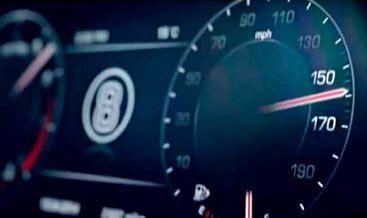


Maximum Vehicle Speed Limit Correction
Maximum Vehicle Speed Limit Correction restores the correct speed parameter inside your Jaguar or Land Rover Car Configuration File (CCF). Every JLR vehicle leaves the factory with a maximum vehicle speed value written into its configuration. That single value shapes engine torque delivery, transmission shift strategy, and instrument cluster speedometer scaling. When the value no longer matches your vehicle’s market specification or its current driveline, drivability, accuracy, and diagnostic consistency all suffer. This service reads the existing value, verifies it against your VIN build record and applicable legislation, then writes the correct parameter through JLR-approved diagnostic pathways.
How Maximum Vehicle Speed Limit Correction Works
The Car Configuration File acts as the master reference for hundreds of vehicle parameters. The maximum vehicle speed value forms one part of that reference, and multiple control modules read it during every drive cycle. The Engine Control Module uses it to shape torque delivery in the upper speed range. The Transmission Control Module uses it to refine shift points and torque converter lockup strategy. The Instrument Cluster uses it to calculate displayed road speed. When these modules receive a value that conflicts with the physical driveline, the vehicle delivers inconsistent behaviour and the speedometer drifts from true road speed.
Three scenarios create this mismatch most often. First, a vehicle imported from another market retains the speed parameter from its original region, so the value no longer suits local road conditions or local requirements. Second, a driveline change such as a differential ratio swap, a transfer case replacement, or a significant tyre diameter change alters the relationship between engine speed and road speed. Third, a module replacement or a software update can reset configuration values to a default that no longer matches the vehicle.
Our process begins with a full CCF read and a comparison against your VIN build data. We identify the current value, confirm the correct target value for your market and hardware, and verify the applicable legal requirement. We then write the corrected parameter, reset the affected modules, and synchronise the network. A road test with GPS verification confirms that displayed speed matches true speed and that the driveline behaves consistently across the full range.
Key Features
- VIN-specific CCF editing aligns the speed parameter with your vehicle’s exact build record.
- Market specification alignment corrects values on imported vehicles from other regions.
- Driveline change support restores accurate calibration after differential, transfer case, or tyre size changes.
- Speedometer accuracy verification confirms displayed speed against a GPS reference during road testing.
- Multi-module synchronisation applies consistent values across the ECM, TCM, Instrument Cluster, and Gateway Module.
- Complete CCF backup preserves your original as-built configuration before we write any change.
- Compliance screening verifies applicable legal requirements before we modify any parameter.
- Diagnostic-safe programming generates no fault codes and keeps every module in a healthy state.
- Full documentation records the original value, the corrected value, and the verification result.
- Remote support guidance helps your local workshop complete the process with confidence.
Technical Specifications
| Parameter | Specification |
|---|---|
| Service Name | Maximum Vehicle Speed Limit Correction |
| Configuration File | Car Configuration File (CCF) – as-built and customer parameter blocks |
| Affected Modules | Engine Control Module, Transmission Control Module, Instrument Cluster, Gateway Module, ABS/DSC Module |
| Typical Applications | Market import alignment, driveline ratio change, tyre diameter change, module replacement recovery |
| Verification Method | GPS road speed comparison against instrument cluster display |
| Diagnostic Platform | JLR-approved diagnostic pathway with DOIP VCI interface |
| Backup Protocol | Full CCF archive captured before modification |
| Compliance Check | Legal requirement verification against vehicle class and market before writing |
| Typical Service Duration | 60 to 90 minutes including road test verification |
| Reversibility | Fully reversible through the archived original configuration |
Vehicle Compatibility
Maximum Vehicle Speed Limit Correction supports a broad range of Jaguar and Land Rover vehicles that use a writable Car Configuration File. Compatible models include:
- Range Rover (L405, L460) from 2013 onward
- Range Rover Sport (L494, L461) from 2013 onward
- Range Rover Velar (L560)
- Range Rover Evoque (L538, L551)
- Discovery (L462) and Discovery Sport (L550)
- Defender (L663)
- Jaguar F-Pace, E-Pace, I-Pace
- Jaguar XE, XF, and XJ models with compatible diagnostic access
We verify your VIN, your current CCF values, and your driveline specification before we begin. Vehicles with recent module replacements or software updates benefit most from this service, because those events frequently introduce configuration drift.
Compliance and Legal Notice
We perform Maximum Vehicle Speed Limit Correction only where applicable law permits the change. Many jurisdictions mandate speed limiters for specific vehicle classes, including commercial vehicles, passenger-carrying vehicles, and newly registered vehicles in certain regions. We verify the legal requirement for your vehicle class and your market before we write any parameter. We decline work that would remove or defeat a legally mandated limiter. We recommend that you confirm local requirements with your vehicle registration authority before you order this service.
What the Correction Includes
- Full CCF read and archive to capture your vehicle’s original configuration.
- Comparison of current values against VIN build data and market specification.
- Legal compliance verification against your vehicle class and local requirements.
- VIN-specific parameter writing across every module that reads the speed value.
- Module reset and network synchronisation after the write completes.
- GPS-verified road test confirming speedometer accuracy and driveline consistency.
- Written documentation recording the original value, the corrected value, and the verification result.
| Make Model | I-PACE 2018-2020 |
|---|
Related products
Features Activation
Features Activation
Features Activation
Features Activation
Features Activation

Features Activation

Features Activation
Features Activation