
Traffic Sign Recognition and Driver Drowsy Monitor (TSR + DDM) — JLR Camera System Activation
Activate Traffic Sign Recognition and Driver Drowsy Monitor on your Jaguar or Land Rover vehicle. Both features run from the forward-facing camera that JLR fits behind the interior mirror. We enable the software functions through official Car Configuration File (CCF) editing with JLR Pathfinder and SDD, then calibrate the camera so the system reads signs and monitors driver behaviour accurately.
These two functions work as a natural pair. Traffic Sign Recognition keeps you informed about the limits that apply on the road ahead. Driver Drowsy Monitor watches for the early signs of fatigue and prompts you to take a break before concentration fades. Together they support safer journeys on long motorway runs, unfamiliar routes, and late-night drives.
What JLR Traffic Sign Recognition Delivers
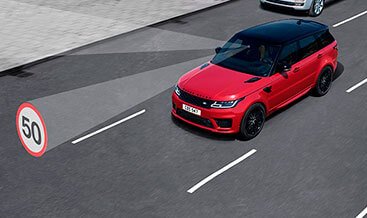
Traffic Sign Recognition (TSR) uses the forward-facing stereo camera to read road signs as you drive. The Image Processing Module (IPMA) identifies speed limit signs, no-overtaking signs, and variable message signs, then cross-references the data against the navigation map. The system displays the current limit on the instrument cluster and, where fitted, on the head-up display.
JLR released TSR in two forms. Speed Limit Information displays the detected limit and any supplementary plate beneath it, such as a wet weather or time-based restriction. Traffic Sign Recognition with Intelligent Speed Limiter goes further: it allows the Adaptive Cruise Control system to adjust your set speed to match the detected limit. Both forms rely on the same camera hardware, so the difference sits in the configuration parameters rather than the physical components.
What JLR Driver Drowsy Monitor Delivers
Driver Drowsy Monitor (DDM), which JLR also markets as Driver Condition Monitor, tracks your driving behaviour and looks for patterns that indicate fatigue or reduced attention. On earlier platforms, the system analyses steering wheel inputs, lane position stability, and driving time through the IPMA and the Power Steering Control Module (PSCM). When the system detects a decline in driver alertness, it displays a message in the instrument cluster and sounds a chime, advising you to take a break.
On later platforms, JLR added an infrared driver monitoring camera mounted in the steering column or instrument binnacle. This camera tracks eye movement, blink rate, and head position, which gives the system a far more direct view of driver state. Vehicles with the driver camera support the full Driver Condition Monitor function, including attention warnings at lower speeds.
Modules and Components We Work With
- Image Processing Module A (IPMA) — The forward camera module that reads signs and supplies lane and driver behaviour data
- Instrument Panel Cluster (IPC) — The display that presents sign icons, limit values, and drowsiness warnings
- Head-Up Display (HUD) — The projection unit that repeats sign information within the driver’s line of sight where fitted
- Power Steering Control Module (PSCM) — The module that supplies steering input data for driver behaviour analysis
- Adaptive Cruise Control module — The module that receives sign data for Intelligent Speed Limiter operation
- Driver Monitoring Camera — The infrared camera that tracks eye and head movement on later platforms
- Gateway Module (GWM) — The module that routes camera, display, and warning messages across the network
- Car Configuration File (CCF) — The vehicle file that registers both features and sets the regional variant codes
Our Activation Process
- VIN Read and Hardware Verification: We read your VIN and confirm that your vehicle carries the forward-facing camera and, where applicable, the driver monitoring camera and head-up display.
- CCF Backup: We download your current Car Configuration File and save a complete backup for your records.
- Parameter Configuration: We edit the TSR and DDM parameters, enable the feature flags, and set the regional variant codes that match your market. This step also confirms whether your vehicle supports Intelligent Speed Limiter.
- Module Coding: We connect our DoIP VCI and write the configuration to the IPMA, IPC, PSCM, and supporting modules through Pathfinder or SDD.
- Camera Calibration: We run the required calibration routine so the forward camera reads signs at the correct distance and angle. Accurate calibration directly affects how quickly TSR responds to a sign.
- Functional Testing: We road-test the vehicle and verify sign detection, display accuracy, warning thresholds, and head-up display presentation where fitted.
- Report: We provide a written record of the parameters we configured and the tests we completed.
Hardware Your Vehicle Needs
Both features need the forward-facing stereo camera behind the interior mirror. JLR fitted this camera to many vehicles as part of a driver assistance pack, so plenty of cars already support a straightforward software activation. Head-up display support depends on the HUD unit, and the driver camera determines which DDM functions your vehicle can run. We confirm every requirement against your VIN before we quote.
Vehicle Compatibility
| Vehicle Era | Diagnostic Platform | Common Models |
|---|---|---|
| 2013–2016 | JLR SDD | Range Rover L405, Range Rover Sport L494, Discovery 4, Evoque L538, Jaguar XF, XJ |
| 2017–Present | JLR Pathfinder | Range Rover L460, Range Rover Sport L461, Velar L560, Defender L663, Discovery 5 L462, Discovery Sport, Jaguar F-Pace, E-Pace, I-Pace |
| 2017–Present | TOPIx Cloud | All models requiring online security authentication |
Driver Responsibility and Compliance
Traffic Sign Recognition and Driver Drowsy Monitor assist the driver; they do not replace the driver. TSR cannot read every sign, and damaged, obscured, or non-standard signs may go undetected. DDM identifies patterns associated with fatigue, yet it cannot measure your actual level of alertness. You remain responsible for observing road signs, following traffic law, and stopping for rest when you feel tired. Use both systems in line with the laws that apply in your region.
Why Choose LR Retrofit
- Official JLR Platforms: We use Pathfinder, SDD, and TOPIx Cloud, the same tools JLR dealers use worldwide.
- VIN-Specific Configuration: Every CCF edit matches your exact vehicle build and market region.
- Accurate Camera Calibration: We calibrate the forward camera so sign detection and lane data stay precise.
- Combined Activation: We configure both features in one session, which saves time and reduces cost.
- Complete Documentation: You receive a written report covering every change and every verification test.
- Remote and Onsite Support: We serve clients across the UK, Europe, Middle East, Africa, and North America.
Book Your TSR and DDM Activation
Ready to add sign reading and fatigue monitoring to your Jaguar or Land Rover? Contact our technical team with your VIN, and we will confirm compatibility, pricing, and scheduling.
Email: info@lr-retrofit.com
Service available: Remote (you connect the VCI) or onsite (our technician attends)
Typical duration: 60–90 minutes for combined activation, plus calibration time where the camera needs realignment