

Adaptive Cruise Control with Stop
Adaptive Cruise Control with Stop transforms long journeys and slow traffic into a relaxed, controlled experience. This OEM retrofit activates the factory radar-guided cruise control on compatible Jaguar and Land Rover vehicles. The system holds your chosen speed, maintains a safe following distance, brings the vehicle to a complete stop when traffic halts, and pulls away again when the queue moves. You keep your hands on the wheel and your attention on the road while the vehicle manages the throttle and the brakes.
How Adaptive Cruise Control with Stop Works
A forward-facing long-range radar sensor mounts behind the front bumper and projects a narrow beam along your lane. The radar continuously measures the distance and the relative speed of vehicles ahead. The Adaptive Cruise Control module combines that radar data with wheel-speed signals, steering angle, yaw rate, and camera information from the Image Processing Module A (IPMA).
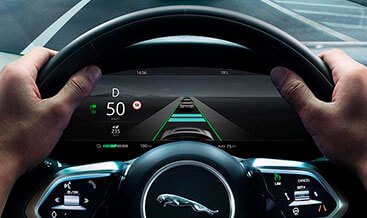
When the road ahead clears, the system holds your set speed by requesting torque from the Engine Control Module. When a slower vehicle appears, the system reduces torque and applies the brakes through the ABS/DSC module. You select one of four following-distance settings using the gap buttons on the steering wheel switch pack. The instrument cluster displays the active gap setting, the detected target vehicle, and the system status.
The Stop function extends this behaviour down to 0 km/h. When traffic comes to a halt, the system decelerates smoothly and holds the vehicle using the Electric Park Brake. If the stop lasts less than three seconds, the vehicle pulls away automatically as the queue moves. If the stop lasts longer, the driver confirms the resume with a tap of the RES button or a brief press of the accelerator. This queue assist behaviour makes congested commuting calm and repeatable.
Our activation service writes VIN-specific Car Configuration File parameters to the ACC module, the ABS/DSC module, the IPMA, the Engine Control Module, the Electric Park Brake module, and the Gateway Module. We align every value with your vehicle’s build data, which guarantees correct braking authority, accurate target tracking, and full driver display integration.
Key Features
- Radar-guided speed control maintains your selected speed with smooth, progressive throttle response.
- Four selectable following distances let you choose a gap that suits traffic density and personal preference.
- Stop function decelerates the vehicle to a complete standstill and holds it with the Electric Park Brake.
- Queue assist pulls away automatically after short stops and confirms resume after longer stops.
- Full speed range operation covers motorway cruising and stop-start urban traffic in one system.
- IPMA camera integration adds lane awareness and improves target selection in curves.
- Instrument cluster display shows the target vehicle, the active gap setting, and system status.
- Steering wheel switch pack provides dedicated SET, RES, and gap controls for intuitive operation.
- Braking intervention uses the factory ABS/DSC module for smooth, controlled deceleration.
- Diagnostic-safe programming generates no fault codes and preserves the original as-built configuration.
Technical Specifications
| Parameter | Specification |
|---|---|
| System Name | Adaptive Cruise Control with Stop (ACC with Stop and Go) |
| Primary Sensor | Forward-facing long-range radar (76–77 GHz) mounted behind the front bumper |
| Supporting Sensor | Image Processing Module A (IPMA) forward-facing camera |
| Control Modules | ACC Module, IPMA, ABS/DSC Module, ECM, EPB Module, BCM, Gateway Module |
| Speed Range | 0 km/h to maximum vehicle speed (full speed range capability) |
| Following Distance Settings | Four selectable gaps via steering wheel switch pack |
| Stop Function | Full deceleration to 0 km/h with Electric Park Brake hold |
| Resume Behaviour | Automatic within 3 seconds; driver confirmation required beyond 3 seconds |
| Transmission Requirement | Automatic transmission only |
| Brake Requirement | Electric Park Brake (EPB) with Stop and Go capable ABS/DSC module |
| Driver Feedback | Instrument cluster target vehicle display, gap indicator, and system status messages |
| Activation Method | VIN-specific CCF configuration via JLR-approved diagnostic pathway |
Vehicle Compatibility
Adaptive Cruise Control with Stop supports a broad range of modern Jaguar and Land Rover vehicles equipped with the required radar sensor, EPB, and compatible brake module. Compatible models include:
- Range Rover (L405, L460) from 2013 onward
- Range Rover Sport (L494, L461) from 2013 onward
- Range Rover Velar (L560)
- Range Rover Evoque (L538, L551)
- Discovery (L462) and Discovery Sport (L550)
- Defender (L663)
- Jaguar F-Pace, E-Pace, I-Pace
- Jaguar XE, XF, and XJ models with compatible brake and radar hardware
Your vehicle must carry an automatic transmission, an Electric Park Brake, and an ABS/DSC module that supports the Stop and Go function. The vehicle also needs a front radar sensor and bracket, a steering wheel switch pack with ACC controls, and a compatible instrument cluster. We verify every hardware element against your VIN before we begin, and we confirm brake module capability during the pre-activation scan. If your vehicle needs the radar sensor, the bracket, or the wiring harness, we supply complete retrofit packages that add the hardware and the configuration together. After installation, we perform target-based radar calibration to align the sensor with the vehicle’s centreline.
What the Activation Includes
Every Adaptive Cruise Control with Stop activation includes a comprehensive configuration service tailored to your vehicle:
- Pre-programming hardware verification covering radar presence, EPB function, brake module capability, and switch pack operation.
- VIN-specific CCF editing to enable ACC, Stop and Go, and queue assist parameters across all control modules.
- Complete CCF backup before modification to preserve your vehicle’s original as-built data.
- Radar calibration using a target reflector to establish accurate alignment and reliable target tracking.
- Module reset and network synchronisation across the ACC, ABS/DSC, IPMA, ECM, and Gateway modules.
- Functional road testing to verify speed holding, gap adjustment, full stop behaviour, and resume logic.
- Remote support documentation for your local workshop or independent specialist.
| Make Model | I-PACE 2021+ |
|---|
Related products
Features Activation
Features Activation

Features Activation
Features Activation

Features Activation
Features Activation
Features Activation
Features Activation