


Traffic Sign Recognition and Driver Drowsy Monitor (TSR + DDM) — OEM Retrofit & Activation for Jaguar and Land Rover Vehicles
Traffic Sign Recognition (TSR) and Driver Drowsy Monitor (DDM) extend your Jaguar or Land Rover vehicle’s forward-monitoring ADAS suite with two complementary safety functions. TSR reads speed-limit and no-overtaking signs through the Integrated Forward Camera (IFC) and reproduces them in the instrument cluster and Head-Up Display. DDM analyses steering behaviour, lane-position stability, and journey duration to detect the early signs of driver fatigue. We deliver this combined retrofit as a software-only activation or a complete hardware-plus-coding installation, depending on your vehicle’s existing camera architecture and CCF trim-level restrictions.
How Traffic Sign Recognition Works on JLR Platforms
JLR engineers built TSR on top of the vehicle’s Integrated Forward Camera (IFC) network. The IFC mounts at the top of the windscreen behind the rear-view mirror housing and captures road imagery continuously. The camera applies pattern-recognition algorithms to identify circular speed-limit signs, derestriction signs, and no-overtaking signs across European, North American, and GCC sign standards.
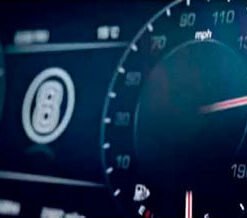
The ADAS-ECU then fuses camera data with navigation map speed-limit information to deliver reliable sign display. When the system detects a valid sign, the instrument cluster (IPC) displays the recognised limit within the driver-information menu, and the Head-Up Display (HUD) projects the same value directly into your line of sight where your vehicle carries that hardware. TSR activates above approximately 5 km/h (3 mph) and holds the last validated sign value until the system recognises a new one or confirms a route change through navigation data. Every recognition threshold, sign-classification parameter, and display-timing value retains original OEM factory-calibration settings.
How Driver Drowsy Monitor Works on JLR Platforms
DDM operates through a different signal path that complements the camera network. The ADAS-ECU continuously evaluates Electric Power Steering (EPS) steering-angle data, lane-position behaviour from the IFC, turn-signal activity, journey duration, and time-of-day variables. The module builds a driver-fatigue model and raises a warning when the calculated risk crosses a factory-specified threshold.
When DDM detects fatigue indicators, it triggers a two-stage alert sequence. First, the instrument cluster displays a driver-attention message and the audio system emits a chime. Second, if the fatigue model continues to escalate, the system repeats the alert and recommends a rest break through the driver-information menu. DDM typically activates above approximately 65 km/h (40 mph) on JLR platforms and runs throughout the journey. The driver retains full control at all times, and the system never intervenes in steering, braking, or throttle operation.
System Components and Technical Specifications
The complete TSR + DDM retrofit includes the following OEM-grade components:
- Integrated Forward Camera (IFC): A genuine JLR windscreen-mounted mono camera that provides sign classification and lane-position data to the ADAS-ECU, with a horizontal field of view of approximately 50 degrees.
- ADAS-ECU Integration: This module processes camera imagery, fuses navigation map data, and builds the driver-fatigue model from EPS and lane-position inputs.
- Instrument Cluster (IPC): The IPC displays recognised traffic signs and driver-attention messages within the driver-information menu.
- Head-Up Display (HUD): Where your vehicle carries this hardware, the HUD projects recognised speed limits directly into the driver’s line of sight.
- Electric Power Steering (EPS) Interface: The EPS module supplies continuous steering-angle data that feeds the DDM fatigue model.
Vehicle Compatibility
Our TSR + DDM retrofit supports all DOiP-capable JLR platforms carrying compatible forward camera hardware or factory provisions for camera installation. Compatible models include:
- Defender (L663, 2020–2026)
- Range Rover (L405, L460, 2013–2026)
- Range Rover Sport (L494, L461, 2014–2026)
- Discovery 5 (L462, 2017–2026)
- Discovery Sport (L550, 2015–2026)
- Evoque (L538, L551, 2012–2026)
- Velar (L560, 2017–2026)
- Jaguar F-PACE (X761, 2016–2026)
- Jaguar XF (X260, 2016–2024)
- Jaguar XE (X760, 2015–2024)
- Jaguar I-PACE (2018–2025)
- Jaguar E-PACE (2018–2024)
Many mid-to-high-specification vehicles arrive from the factory with the forward camera already fitted, yet factory CCF trim-level restrictions disable both feature sets. Our dealer-level Pathfinder DOIP programming removes these software barriers and activates the complete TSR and DDM logic.
The Retrofit Process
We perform every TSR + DDM retrofit using certified JLR Pathfinder DOIP programming. The process follows four defined stages:
- Pre-Scan Diagnostics: We verify the health and compatibility of your vehicle’s forward camera, EPS module, IPC, HUD, and gateway. This step confirms whether your vehicle requires software-only activation or a complete hardware-plus-coding installation.
- CCF Configuration Updates: We modify validated CCF build-file flags within the IFC, ADAS-ECU, IPC, HUD, and gateway (GWM) to unlock dormant TSR and DDM logic. This approach preserves all factory recognition thresholds, fatigue-model parameters, and diagnostic-logging routines.
- Camera Calibration: Where camera installation is required, our technicians mount the IFC in the factory-specified windscreen position and perform static and dynamic calibration using JLR-approved diagnostic equipment. This calibration delivers the sub-millimetre alignment accuracy that sign recognition demands.
- Post-Activation Validation: Our JLR-certified technicians verify sign-display accuracy, HUD projection behaviour, chime output, and driver-attention messaging on-road. We confirm zero fault codes and full feature usability before completing the service.
Key Benefits of the TSR + DDM Retrofit
- Continuous Speed-Limit Awareness: TSR keeps the current posted limit in your line of sight, which supports confident compliance in unfamiliar areas and changing speed zones.
- Early Fatigue Detection: DDM identifies steering and lane-position changes that indicate drowsiness before fatigue affects your driving, then prompts a rest break.
- Dormant Hardware Unlock: Many JLR vehicles carry factory-fitted camera and EPS electronics locked behind CCF software restrictions. Our activation unlocks this latent safety hardware without physical modifications.
- Full OEM Integration: The retrofit uses genuine JLR components and factory programming protocols. It maintains complete vehicle system integrity and triggers no warning lights or ADAS DTC faults.
- Foundation for Lane Assist Functions: TSR and DDM activation establishes the camera calibration and coding foundation that supports Lane Departure Warning, Lane Keep Assist, and Traffic Jam Assist retrofits.
- Permanent Feature Stability: Both functions persist through battery resets, system scans, and official JLR software updates.
Ordering and Installation
We deliver the TSR + DDM retrofit as an on-site installation or through our nationwide mobile service. Each package includes full pre-programming diagnostic scanning, factory CCF configuration updates, camera calibration where required, and post-code system validation. Our JLR-certified technicians complete every installation using OEM procedures and OEM components.
Contact our team today to confirm your vehicle’s compatibility and schedule your TSR + DDM retrofit. We will verify your vehicle’s camera and HUD hardware configuration and recommend the correct activation path for your model.