


2.0 INGENIUM Petrol P200 to P250 Factory Upgrade
Product Code: LR-RETRO-P200-P250-20 | Vehicle: Land Rover Discovery Sport (L550), Range Rover Evoque (L538/L551), Range Rover Velar (L560) | Engine: 2.0L AJ200 INGENIUM I4 Petrol Turbo
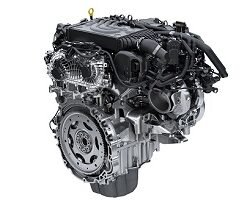
Welcome to the definitive JLR technical guide for upgrading your 2.0L INGENIUM petrol engine from P200 to full P250 factory specification. The P200 and P250 variants of the AJ200-series engine share the same short block and cylinder head but differ in turbocharger specification, intercooler size, and ECU calibration. Our upgrade provides a complete conversion package: turbocharger, intercooler, and ECU calibration to match the exact factory P250 powertrain configuration used by Land Rover across the Discovery Sport, Evoque, and Velar model lines.
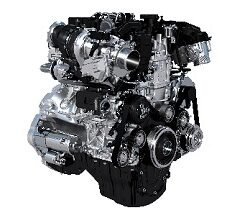
Technical Overview: The 2.0L AJ200 INGENIUM Petrol
The AJ200 INGENIUM petrol engine is a direct-injection, turbocharged, 1,997cc inline-four with an aluminium block and head, dual independent variable valve timing (DIVCT), and a compression ratio of 10.5:1. Both P200 and P250 variants use a twin-scroll turbocharger from Mahle (also known as BorgWarner equivalent). The key hardware differences are:
- Turbocharger: P200 uses a Mahle J8G2 11.3 (smaller turbine housing, wastegate-actuated). P250 uses a Mahle J8G2 11.6 (larger turbine housing, electronically controlled wastegate with higher flow capacity).
- Intercooler: P200: air-to-air charge air cooler (core volume ~4.2 litres). P250: air-to-air charge air cooler (core volume ~5.5 litres, 31% larger).
- ECU: Both use Bosch MG1CS001 (MED17.8.x). The P250 calibration features higher boost targets (up to 1.6 bar absolute vs 1.3 bar), increased fuel injector open time, and revised ignition timing maps.
- Exhaust System: The P250 uses a slightly less restrictive rear muffler (lower backpressure), but this is not mandatory for the power gain; the turbo and intercooler deliver the majority of the increase.
Without hardware upgrades, a simple remap on a P200 can safely achieve approximately 230–235 hp, but the wastegate actuator and turbine wheel of the P200 turbo cannot sustain the airflow required for 250 hp without entering surge or exceeding maximum turbine speed. Our conversion addresses both the turbo and intercooler limitations.
Performance Comparison: P200 vs P250 (Factory Spec)
| Parameter | P200 (Stock) | P250 (After Upgrade) | Gain |
|---|---|---|---|
| Power (PS / hp) | 200 PS (147 kW) | 250 PS (184 kW) | +50 PS (25%) |
| Torque (Nm) | 320 Nm @ 1,500–4,000 rpm | 365 Nm @ 1,300–4,500 rpm | +45 Nm (14%) |
| 0-100 km/h (sec)* | 7.6 sec (Discovery Sport) | 6.5 sec (Discovery Sport) | -1.1 sec |
| Top Speed (km/h) | 200 km/h | 225 km/h | +25 km/h |
| Fuel Economy (combined WLTP) | 7.8 L/100km | 7.7 L/100km | Negligible difference |
| Boost Pressure (absolute) | 1.3 bar max | 1.6 bar max | +0.3 bar |
| Turbocharger | Mahle J8G2 11.3 | Mahle J8G2 11.6 | Hardware swap required |
| Intercooler Volume | 4.2 litres | 5.5 litres | Hardware swap required |
* 0-100 km/h times vary by vehicle variant and drivetrain; shown for Discovery Sport 4WD automatic.
What is the Difference Between 2.0 INGENIUM P200 and P250?
The P250 is not a “tuned” P200; it is a separate engine variant with a larger turbocharger (higher flow turbine housing and electronic wastegate), a larger intercooler, and a factory ECU calibration that increases boost by 0.3 bar and extends the fuel injection window. The P200’s smaller turbo would experience turbine inlet temperatures exceeding 950°C if asked to deliver 250 hp, risking material failure of the Inconel wheel. The lower intercooler volume on the P200 also leads to higher intake air temperatures (IAT) above 65°C when power is pushed past 220 hp, which causes the ECU to pull timing. Our upgrade eliminates both bottlenecks.
Click to expand: Detailed Hardware Specifications
- P200 Turbo: Part number LR117590 / LR0221577 – twin-scroll, wastegate actuator, turbine wheel diameter 38mm.
- P250 Turbo: Part number LR117591 / LR0221578 – twin-scroll, electronic wastegate, turbine wheel diameter 42mm.
- Intercooler P200: Core dimensions 550×250×50 mm.
- Intercooler P250: Core dimensions 650×280×55 mm.
- Fuel system: Both use Bosch HDP5 high-pressure pump (200 bar peak). Injector flow rate is identical (120 cc/min at 200 bar). The P250 calibration simply opens the injectors for a longer duration.
Upgrade Process: JLR Technical Workflow
- Vehicle Assessment: We verify the engine code (AJ200P200 vs AJ200P250) via the VIN or OBD read. We check that the vehicle does not already have a factory P250 ECU (some late models may have been misidentified).
- Hardware Removal:
- Remove the front bumper assembly and release the charge air cooler ducts.
- Remove the original P200 intercooler and replace with the larger P250 intercooler (brackets, hoses, and clamps included).
- Remove the P200 turbocharger (requires exhaust manifold removal). Replace with the P250 turbocharger. New gaskets, oil feed pipe, and coolant return pipe supplied.
- ECU Read and Calibration: Using a BDM interface or TC1793 boot mode, we read the Bosch MG1CS001 ECU. We then apply the factory P250 calibration maps, including:
- Boost pressure target table (increased by 0.2–0.3 bar across the operating range)
- Wastegate duty cycle map (adapted for the electronic actuator)
- Fuel injection duration map (extended by 15% at full load)
- Ignition timing map (retarded slightly at high boost to prevent knock, then advanced at mid-load for torque)
- Torque limiter map (increased to 400 Nm for transmission protection – the ZF 9HP48 is rated for 480 Nm)
- Hardware Installation: The intercooler and turbo are installed. All gaskets, O-rings, and seals are replaced with OEM-grade parts. We also recommend replacing the spark plugs (same NGK DILKAR7A10) if overdue.
- Validation: We perform a road test with live data logging (boost pressure, IAT, lambda, knock sensor activity, EGT). We confirm the calibration stays within JLR safety margins: peak cylinder pressure < 120 bar, EGT < 850°C, no knock events above -2° retard.
Why Choose LR-Retrofit for Your P200 to P250 Conversion?
- Complete Hardware + Software Package: We provide the P250 turbocharger, intercooler, all required gaskets, and the ECU calibration as a single kit. No sourcing of used parts.
- Factory-Spec Calibration: Our calibration is derived from genuine JLR P250 factory files (model year 2018+), ensuring OEM drivability, cold-start behaviour, and emissions compliance (EU6d).
- Transmission Protection: We calibrate the torque limiter to 400 Nm for the ZF 9HP48 transmission (factory P250 torques are 365 Nm). This protects the torque converter clutch from excessive slip.
- Vehicle-Specific: We differentiate between Discovery Sport (L550), Evoque (L538/L551), and Velar (L560) calibrations due to differences in vehicle inertia, gearbox mapping, and cooling fan control.
- No Check Engine Lights: We disable any DTCs related to the turbocharger swap (e.g., wastegate position sensor mismatch, boost pressure plausibility). The conversion operates as a true factory SD4 (petrol equivalent).
Be the first to review “2.0 INGENIUM Petrol P200 upgrade to P250 factory versions”
You must be logged in to post a review.
Related products
Power Upgrade


Power Upgrade
Reviews
There are no reviews yet.